
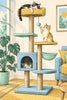
How to Choose the Right Cat Tree for Your Home
, by My Furry Fren Editorial Team, 7 min reading time
, by My Furry Fren Editorial Team, 7 min reading time
A cat tree is one of the few pieces of cat furniture that does real behavioral work. Cats are arboreal by instinct — they feel safest up high, where they can watch their world and escape the floor-level traffic of a busy home. The right tree channels climbing, scratching, and resting into one spot instead of your sofa and shelves. The wrong one wobbles, wastes space, or gets ignored. This guide walks through the factors that matter so you can pick a tree your cat will actually use.
Height is security for a cat. In multi-cat homes, vertical space reduces conflict because cats can avoid each other without confrontation. Climbing also provides exercise, and scratching posts protect furniture by giving claws a legitimate target. A cat tree combines territory, exercise, and stress relief in a single footprint — which is why it is one of the most-recommended enrichment purchases for indoor cats.
Measure your space and think about traffic flow before you buy.
Different cats need different setups:
Browse our cat trees and towers to compare heights and configurations, and look at hammocks and perches for cats that prefer to lounge up high.
Scratching is not optional behavior — it conditions claws and marks territory. The material matters:
Provide at least one tall vertical post and one horizontal surface, since cats have different scratching postures. Fully wrapped posts discourage scratching the sofa far better than a short stub.
Cats use a tree as a bed as much as a jungle gym. Look for:
One comfy perch with a good view is often the single most-used spot in the house.
Quality matters more than a long list of features. Check:
Recheck bolts after a few weeks of use, and tighten anything that has loosened.
A cat tree is not the only way to add vertical space, and many homes do best with a combination. Floor-standing trees provide territory, scratching, and a cozy condo in one unit, while wall-mounted shelves and window perches add climbing routes and lookout points that use no floor space at all. Hammocks and window-mounted beds are ideal for cats who love to sunbathe and watch the outdoors.
For a solo cat in a small flat, a single stable tree plus a window perch often covers everything. In a busy multi-cat home, spreading several climbing and perching options around different rooms reduces competition and gives each cat its own zone. The goal is choice: cats relax most when they can pick between high, low, hidden, and open resting spots, and can move between them without passing another cat.
A new tree is unfamiliar, so give your cat a nudge:
You do not need a huge tower to give a cat vertical territory. In a small apartment, prioritize quality over scale:
A single well-placed, stable tree often gets used more than several cramped, wobbly ones.
Most unused trees fail for predictable reasons:
Fix these and most cats will adopt the tree within days.
Cheaper trees often wobble, shed carpet, and wear out fast. A well-built tree with replaceable scratching posts usually lasts longer and costs less per year of use. Prioritize stability, materials, and repairability over the number of dangling toys. Replace frayed posts and torn carpet before they become a hazard.
A cat tree cannot fix every behavior. Talk to your veterinarian if your cat shows:
Mobility changes in an older cat deserve a check — arthritis is common and often manageable.
How tall should a cat tree be? Tall enough for your cat to perch above normal household activity — often 4 feet or more. Confident climbers do well with taller towers.
Where should I put a cat tree? Near a window with a view, in a spot your cat already favors, and away from drafts and busy doorways.
Do cats use cat trees? Most do when the tree is stable, well-placed, and introduced with play and catnip.
What scratching material is best? Sisal rope suits most cats; some prefer cardboard or carpet. Offering a variety helps.
How many cat trees do I need? One good tree per one or two cats is a solid start; multi-cat homes benefit from more vertical options.
The right cat tree gives your cat height, territory, scratching, and a place to sleep — all in one footprint. Choose based on stability, size, placement, and scratching surfaces matched to your cat, then introduce it with play, catnip, and treats. Prioritize quality over feature count, keep the hardware tight, and watch for mobility changes that could mean your cat needs a lower, easier setup. Built and placed well, a good tree becomes the most-used real estate in your home.


