
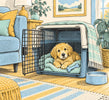
Crate Training a Puppy: The First 7 Nights
, by My Furry Fren Editorial Team, 7 min reading time
, by My Furry Fren Editorial Team, 7 min reading time
Done kindly, crate training gives your puppy a calm, safe space of their own. It makes house training, travel, and vet visits far easier, and it gives you somewhere safe to put your puppy when you can't watch them every second. The goal is for the crate to become your puppy's favourite spot — somewhere they choose to relax, not somewhere they're locked away as punishment.
The first week sets the tone. Expect some protest, move slowly, and stay close by. Here's a night-by-night plan for the first seven nights and the habits that make them work.
A crate taps into a dog's natural instinct to den. Denning animals feel secure in a small, enclosed space they consider their own. That's why a well-introduced crate soothes anxious puppies rather than trapping them. The benefits stack up quickly:
Preparation does more for night one than any amount of soothing in the moment.
Your puppy will probably whine, and that's completely normal. They've just left their littermates and everything is new. Sit beside the crate, speak in a low, calm voice, and offer reassurance. Open the door only when your puppy is quiet — even for a second — so you don't accidentally teach that whining is the way to get out.
If the crying is intense, a quick potty break in the dark, with no play and no chat, can help. Then straight back into the crate. Keep the room dim and boring so "out" never becomes more interesting than "in".
Routine is where crate training wins. Take your puppy out for a final potty right before bed, then again during the night for the first week or two. Young puppies simply can't hold it for long.
Use the same short cue each time — a quiet "go potty" — and take them straight back to bed afterwards. No fuss, no rewards beyond a calm word. Consistency beats perfection; the same sequence every night teaches your puppy what to expect.
As your puppy settles, gradually extend the time between breaks. You can also start covering the crate on three sides with a light blanket for a more den-like feel, making sure air can still flow. Continue to keep the crate positive in the daytime with treats, meals, and open-door naps.
By the end of the first week, many puppies are sleeping in longer stretches and settling faster at bedtime. Progress isn't always linear — a bad night can follow two good ones — but the trend should be in the right direction.
Sleep at night is built during the day. A few simple habits do a lot of the heavy lifting:
Crate style matters less than fit and security. Wire crates give airflow and a clear view, which suits most puppies. Plastic "flight" crates feel more enclosed and den-like. Soft-sided crates are light for travel but not suited to strong chewers. Whichever you choose, the size rule stays the same: room to stand, turn, and stretch out, but not so much space that your puppy can potty at one end and sleep at the other. For a growing dog, a crate with a divider lets the space grow with them.
Keep it simple and safe. A soft, washable blanket or mat, one safe chew toy, and a familiar-smelling item are usually enough. For young puppies who chew fabric, choose a thin mat that can't be shredded and swallowed, and hold off on loose bedding until you know they won't eat it.
Leave out anything that could be a hazard when you're asleep or away: collars and tags (they can catch), long cords, food bowls, and toys with parts that can break off. Water overnight is optional — a tipped bowl soaks the bedding and can cause accidents. If your puppy seems thirsty, offer a small drink before bed instead.
Crate-training whining is normal, but some behaviour needs a professional's eye. Contact your vet if you see:
Your vet can rule out medical causes and recommend a trainer or behaviourist if anxiety is the root problem. Keep crate sessions short, positive, and frequent. If your puppy panics, back up a step rather than pushing through — safety and confidence come first, and slow progress is still progress.
How long can a puppy hold it overnight? Roughly one hour per month of age, with a break in between. A three-month-old may need one or two night trips.
Should I let my puppy "cry it out"? No — comfort briefly, then return to bed. Harsh cry-it-out can damage confidence and slow training.
Should the crate stay in my bedroom? For the first week or two, yes. Being nearby reassures a young puppy. You can move it later once nights are calm.
When can I stop using the crate? Many dogs do well with a crate for life as a comfy den. Once your dog is reliable, you can leave the door open.
Go slow, keep it positive, and stay nearby for the first few nights. A crate that feels like a safe den — introduced with treats, meals, and patience — turns bedtime from a battle into a routine. Expect some protest early on, then steady progress.
Choose a comfortably sized crate or dog house for your puppy's adult size, and keep the crate positive with a safe chew toy.


