
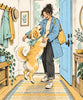
How to Stop Your Dog from Jumping Up (Kindly & Effectively)
, by My Furry Fren Editorial Team, 7 min reading time
, by My Furry Fren Editorial Team, 7 min reading time
A jumping dog is usually a happy dog — but paws on your chest, muddy prints on your guests, and a knocked-over toddler are not so welcome. The good news is that jumping is one of the most fixable behaviors in dogs, and you can change it without yelling, kneeing, or scaring your best friend. The trick is to remove the reward for jumping and reward the calm behavior you actually want.
Dogs jump up for a very simple reason: faces are important. When dogs greet each other, they often go nose-to-nose, and jumping brings them closer to our faces. Puppies jump to reach us, and most dogs quickly learn that jumping gets a reaction — even a negative one.
There are usually three ingredients: excitement, greeting instinct, and attention. If any of those is rewarded, the behavior grows stronger. That is why a dog may jump on strangers but not on you — the audience changes the payoff.
Puppies often start by jumping at their littermates and their mother, then transfer the habit to people. Because the behavior is rewarded early and often, it becomes deeply practiced by adulthood. The important takeaway is that jumping is not a sign of disrespect or a need to “show who is boss” — it is a normal greeting behavior that simply got rewarded.
Pushing your dog down, kneeing them, or shouting may feel satisfying in the moment, but it usually makes jumping worse. Physical contact is often read as play or attention, and a loud reaction is still a reaction. Punishment can also create fear, hand-shyness, and a damaged relationship — and it never teaches the dog what to do instead.
Modern training focuses on what to do, not just what to stop. A dog who is rewarded for sitting has no reason to jump, and the lesson sticks because it is built on cooperation rather than fear.
The most powerful tool you have is your attention. When your dog jumps, withdraw it completely:
For a persistent jumper, step away or step through a doorway so the fun literally stops. The instant your dog is calm, the attention returns. This teaches a clear equation: jumping makes you go away; calm makes you come back.
A dog cannot jump and sit at the same time. A solid “sit” is the single best substitute behavior you can build. Practice it everywhere — in the kitchen, at the front door, on walks — and pay generously with small training treats. Soon sitting becomes the dog’s default way of asking for anything.
Keep greetings boring at first. A calm hello teaches your dog that calm is what unlocks affection, while a wild party teaches them to be wild to get one.
Start practicing somewhere easy, like the hallway, before you try the front door. Build distance and difficulty slowly. If your dog succeeds three times out of four, you are moving at the right pace; if they fail more than that, make the setup easier.
Jumping comes back fast when one person rewards it. Everyone in the home should use the same rule, and guests should be coached quietly before they arrive. Hand them a treat and a one-line script: “Ask for a sit, then pet calmly.” If your dog simply cannot contain themselves, put them on a leash for greetings so you can gently guide them into a sit.
The front door is the hardest classroom because the excitement is highest. Try these setups:
On walks, ask people to ignore your dog until all four paws are down — even a friendly “hi, puppy!” rewards the jump. For dogs who leap on other dogs during play, a short break and a calm restart helps. Interactive toys and structured games can burn off some of that “greeting energy” before it becomes a problem.
Jumping is not only a greeting behavior. Many dogs leap up during play, when they are over-aroused, or when they are trying to grab a toy from your hand. In those moments, a quick pause works wonders: stop the game, wait for all four paws on the floor, then resume. This teaches your dog that staying grounded keeps the fun going.
If your dog cannot calm down no matter what, end the play session and offer a chewy or a puzzle toy instead. Sometimes a jumpy dog simply needs a more structured outlet than free-for-all wrestling.
It is tempting to excuse a tiny dog who jumps, but the same rules apply. A jumping Chihuahua today can become a jumping Chihuahua who trips an elderly guest tomorrow. Kindness is consistency, regardless of size.
Contact your vet or a certified trainer if jumping comes with mouthing, growling, or hard contact, or if your dog seems anxious, fearful, or over-aroused rather than simply excited. Sudden new jumping, especially with limping or reluctance to move, can also be a medical red flag. A professional can rule out pain and build a safe plan.
How long does it take to stop jumping? With total consistency, many dogs show clear improvement in one to three weeks — longer if the habit is well practiced.
Should I knee my dog in the chest? No. It risks injury, reads as attention or play, and can create fear. Withdraw attention instead.
Why does my dog only jump on visitors? Because visitors are new, exciting, and often reward the behavior. Coach guests to ask for a sit.
Is it ever okay to let my dog jump? Only if you consistently invite it, such as on cue. Mixed signals teach confusion.
Will ignoring my dog hurt their feelings? No. You are withdrawing attention for a split second, not affection itself — calm behavior earns plenty of praise right after.
Jumping up is rarely medical, but check with your vet if the behaviour began suddenly, if your dog seems painful or stiff when standing or moving, or if the jumping is repetitive and compulsive. Signs like these point to an underlying problem rather than a training gap.
Stopping jumping is not about dominance — it is about removing the reward and replacing the behavior. Withdraw attention for jumping, reward a calm sit, keep everyone consistent, and practice at the door. Kind, patient training works faster than punishment, and it builds a dog who greets people politely for life.


